 91-9711165183


A personal loan for real estate agents is a standard unsecured loan taken under the self-employed category, where lenders assess commission income from your ITRs and bank statements rather than a fixed salary. Agents with a steady two-to-three-year track record, a clean banking trail and a credit score above 700 can access rates starting around 9.99% to 11% per annum for the strongest profiles (as of June 2026), with the wider self-employed market running higher.
Every agent knows the rhythm of the work: quiet weeks, then a closing that brings in a large cheque. That pattern is exactly what makes a lender pause, not because the income is small, but because it is uneven. The good news is that lenders underwrite commission earners all the time; they simply want to see the average, not the spikes. Present a consistent annual picture and a real estate agent is a perfectly fundable borrower. This guide shows how.
The first thing a lender wants to establish is how you earn, because the evidence differs sharply between the two common setups.
| Salaried agent (at a firm) | Independent broker | |
|---|---|---|
| How you earn | Salary, often plus incentives, from a broking firm | Commission/brokerage from clients and developers |
| Assessed as | Salaried, on salary slips and bank credits | Self-employed, on ITRs and bank statements |
| Key proof | Salary slips, Form 16, bank statements | ITRs, bank statements, Form 26AS (194H), GST returns |
| Typical edge | Quicker, often finer rate | Larger ticket possible with strong financials |
If you draw a salary from a broking firm, you are assessed largely as a salaried professional and the process is quick. If you are an independent, RERA-registered broker, you are self-employed, and the work shifts to presenting your commission income clearly. The rest of this guide focuses on the independent case, since that is where the real questions lie.
Commission income is lumpy by nature, so lenders smooth it out by looking across a full year or more and triangulating a few sources. The more of them that agree, the better your terms.
| Evidence | What it tells the lender |
|---|---|
| Income tax returns (2 to 3 years) | Declared, tax-paid commission income, averaged across the year |
| Bank statements (6 to 12 months) | Actual commission credits, balance stability through quiet periods |
| Form 26AS / AIS | Brokerage corroborated by Section 194H TDS (5% on commission over ₹15,000 a year) |
| GST returns (if registered) | Turnover and continuity for a registered agent (18% GST on brokerage) |
| RERA registration | Credibility: a legally registered, identifiable real estate professional |
Our read: your Form 26AS is quietly one of your strongest assets, because the 5% TDS deducted under Section 194H is independent proof that a developer or client actually paid you brokerage. Combine that with a clean banking trail and an unbroken ITR history, and your uneven income starts to read as a stable annual figure. [VERIFY: 194H rate and threshold against the latest Income Tax provisions]
Lean on your RERA registration. Operating as a registered RERA agent is not just a legal requirement, it is a credibility marker. It tells a lender you are an identifiable professional running a continuing business, which supports the case that your commission income is durable rather than incidental.
Average your income honestly, and bank it cleanly. Because one big closing can distort a single month, route all commissions through one primary account and let your 12-month statements and ITR tell the averaged story. A clean, single banking trail does more for your application than any one large credit.
Yes, when you can evidence income. Because the loan is unsecured, the lender underwrites your repayment capacity, and for an independent agent that means documented commission income and a credit history, not a salary slip. Common requirements look like this (indicative, as of June 2026, confirm with the lender):
| Criterion | Typical requirement |
|---|---|
| Profession | Self-employed real estate agent / broker (or salaried agent at a firm) |
| Business vintage | Around 2 to 3 years of commission income |
| Income proof | ITRs for the last 2 to 3 years plus 6 to 12 months’ bank statements |
| Minimum income | Often from around ₹15,000 to ₹25,000 per month, lender-dependent |
| Age | Typically 21 to 65 years [VERIFY: lender-specific] |
| Credit score | 700+ improves approval and pricing |
A note on tax filing: commission agents generally cannot use the presumptive schemes that some professionals use, and typically file ITR-3 with books of account. That is fine for a lender, what matters is a consistent, credible declared income.
Independent agents borrow under the self-employed personal loan, so the available rates are the standard self-employed rates, usually a little above salaried pricing. Treat these as “starting from” figures for the strongest profiles, subject to eligibility, not guaranteed offers.
| Lender | Interest rate (p.a., starting) | Indicative amount | Processing fee |
|---|---|---|---|
| HDFC Bank | From 9.99% (self-employed priced higher) | ₹50,000 to ₹40 lakh | Up to ₹6,500 + GST |
| ICICI Bank | ~11.25% to 14% (3+ years of ITR) | As per eligibility | Up to 2% |
| Axis Bank | From 9.99% | As per eligibility | Up to 2% |
| Bajaj Finance | From 10% | Up to ₹40 lakh | Up to ₹4,999 or 2.5% |
Rates, amounts and fees as of June 2026 and subject to change. Self-employed applicants generally pay a little more than salaried borrowers because of income variability; an agent with three clean years of ITR and a stable banking trail can negotiate toward the lower band. Confirm the live rate and fee directly with the lender before applying.
The practical takeaway: the all-in cost (rate plus processing fee plus any foreclosure terms) decides it, not the headline banner. If you bank with a lender already, start there, existing customers often see pre-approved or preferential pricing.
Loan size scales with documented income and existing obligations; strong, well-evidenced agents can reach the upper end of the self-employed range, up to ₹40 lakh at some banks. The illustration below sizes the EMI to a ₹5 lakh loan, a common agent ticket, at rates that reflect self-employed pricing. These are computed for illustration only; your EMI depends on the rate you are offered.
| Loan amount | Interest rate (p.a.) | Tenure | Approx. EMI |
|---|---|---|---|
| ₹5,00,000 | 12% | 36 months | ₹16,607 |
| ₹5,00,000 | 12% | 60 months | ₹11,122 |
| ₹5,00,000 | 16% | 36 months | ₹17,579 |
| ₹5,00,000 | 16% | 60 months | ₹12,159 |
Illustrative EMIs only, computed on a standard reducing-balance basis. Property markets are seasonal and cyclical, so size the EMI against a quiet quarter, not a record one. Run your own numbers on an EMI calculator with the actual offered rate before you commit.
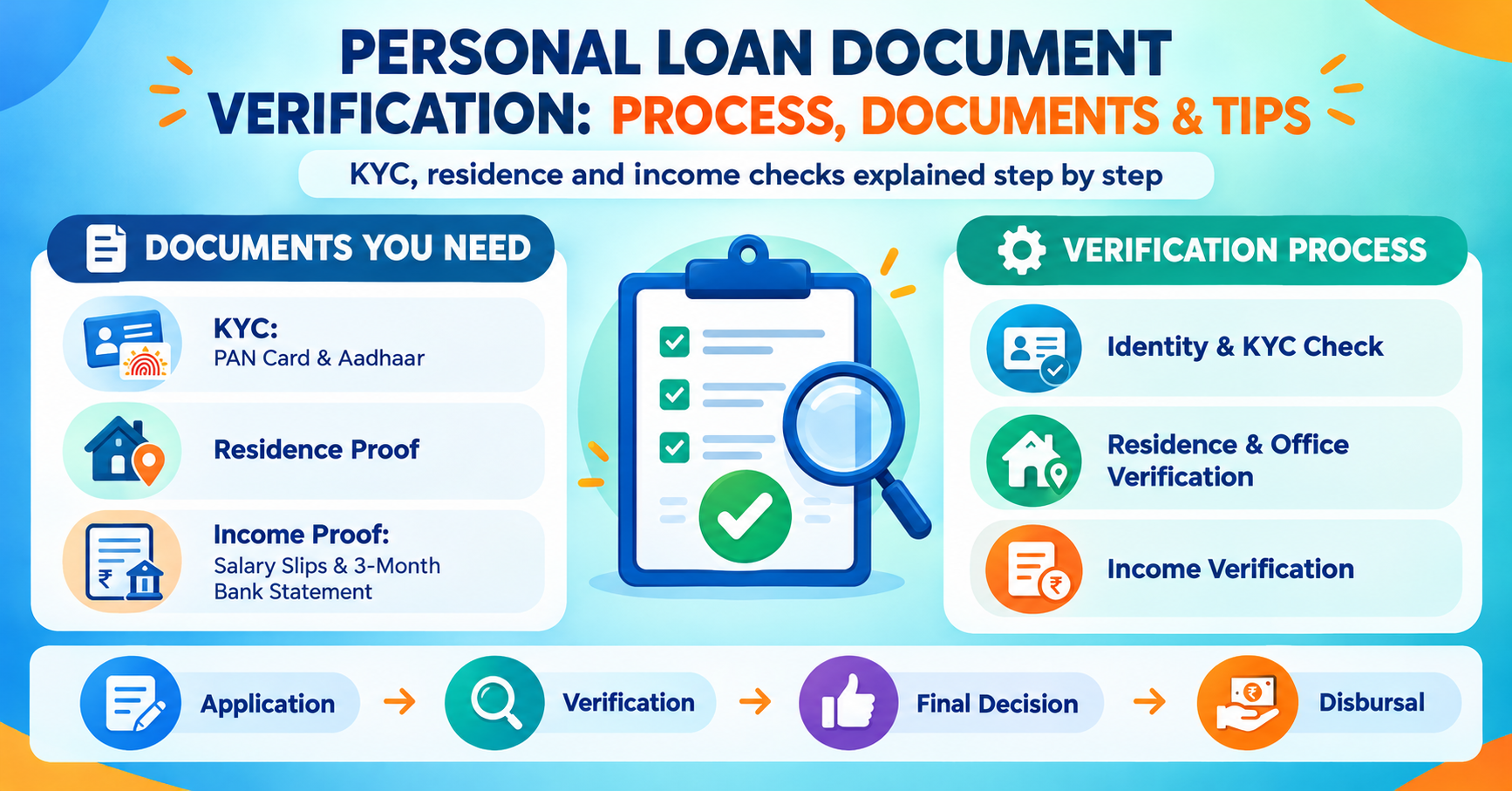
The set is heavier than a salaried applicant’s, but assembling it well is exactly what speeds approval. Keep these ready:
A practical edge: a tidy, well-presented file, ITR, statements, 26AS and RERA certificate in order, genuinely speeds underwriting and can help you argue for a finer rate.
Bring the same diligence you bring to a closing.
Applying to lenders one at a time is slow, and every formal application can leave a footprint on your credit report. At yourloanadvisors.com we help real estate agents compare personal loan offers across multiple lenders in one place, matched to how you earn, whether you are salaried at a firm or an independent RERA-registered broker, along with your ITR history and credit profile. You see where you are likely to be approved, and at what rate, before you commit to a formal application. Prefer to talk it through? Our advisors can help you present your commission income in its strongest light.
Ready to compare? Check your eligibility with yourloanadvisors.com and see agent-friendly personal loan offers side by side, with no obligation.
Yes. Salaried agents at broking firms are assessed like salaried borrowers; independent brokers are assessed as self-employed, on ITRs and 6 to 12 months of bank statements showing commission credits, plus a credit score. Consistent, documented income is the key to approval.
Through ITRs for the last 2 to 3 years, bank statements showing commission credits, and Form 26AS reflecting TDS deducted under Section 194H on brokerage. GST returns and a RERA registration certificate further strengthen the file by evidencing a registered, continuing practice.
Starting rates for the strongest self-employed profiles are around 9.99% to 11% per annum from leading banks (as of June 2026), with the wider self-employed market spanning roughly 9.98% to 24%. Your actual rate depends on income stability, credit score, amount and lender.
Indirectly, yes. RERA registration marks you as a legally registered, identifiable professional running a continuing business, which supports the case that your commission income is durable. Approval still rests mainly on your documented income and credit profile.
It depends on documented income and existing obligations. Strong, well-evidenced agents can reach the upper end of the self-employed range, up to around ₹40 lakh at some banks, while a typical ticket is smaller. The exact amount is set by your ITR-declared income, bank inflows and credit score.
Interest rates, fees, eligibility criteria, loan amounts and tax provisions mentioned here are indicative, sourced as of June 2026, and subject to change at the lender’s or the authorities’ discretion. This article is information, not financial or tax advice. Please confirm current rates and eligibility directly with the lender, and tax treatment with a qualified professional, before acting.