 91-9711165183
 October 13, 2026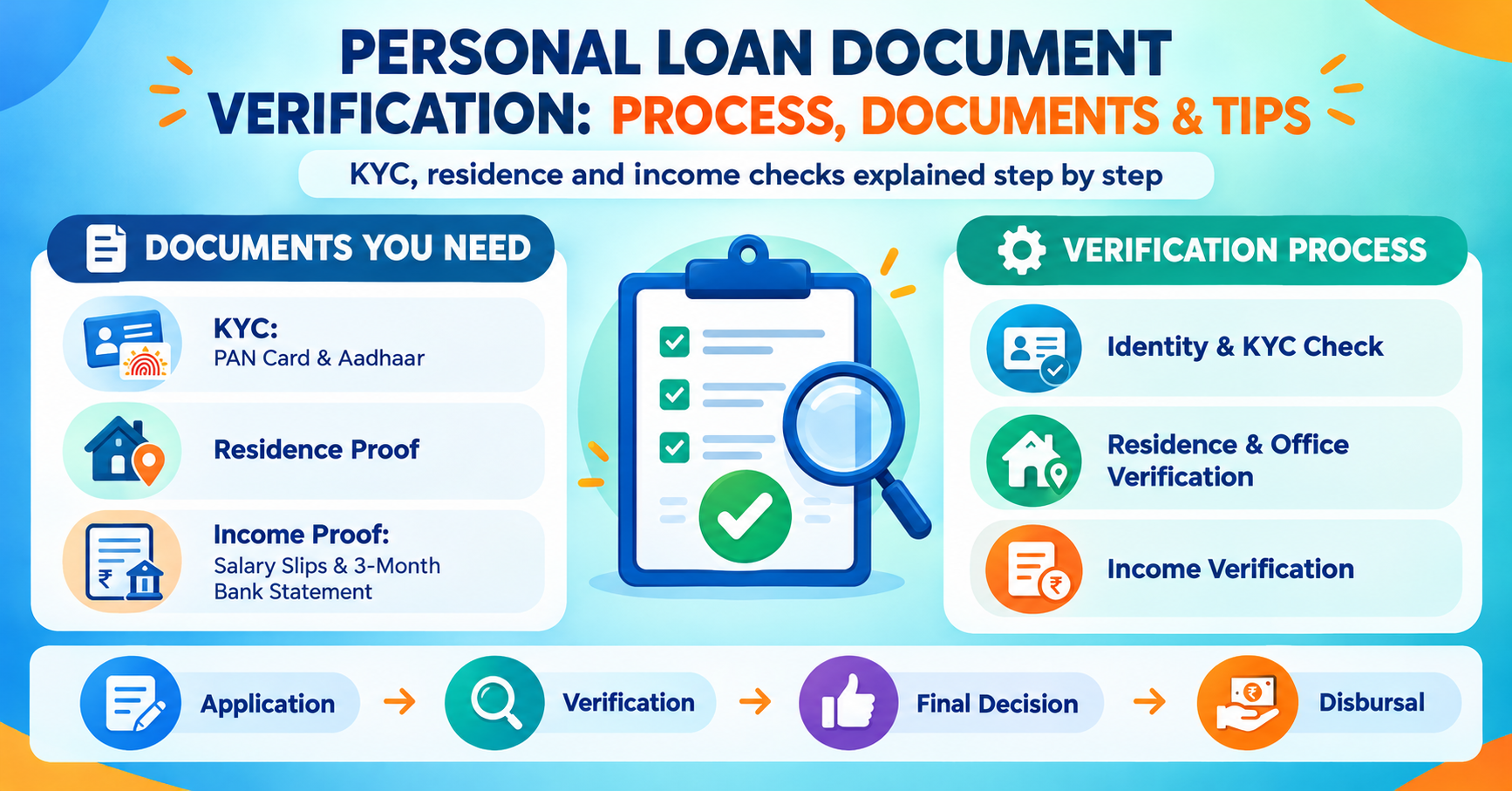
Banks and NBFCs issue unsecured personal loans for individual use. Personal loan verification is an essential part of the personal loan process and is based on the income and KYC documents submitted to the lender. Submitted documents are verified to ensure they are valid copies and to eliminate risk.
Ensuring accuracy in your documents is vital to build trust in your application and helps avoid rejection, making the process faster and smoother. To ensure successful personal loan verification, it is vital to understand the process and its crucial role in loan approval.
Table of Contents
As per the RBI guidelines, it is mandatory to conduct a KYC (Know Your Customer) check to confirm identity and prevent fraud. The primary document required as Identity proof is the PAN Card.
PAN Card (Permanent Account Number): A PAN card is a document issued by the Income Tax Department of India to all Indian citizens. It is mandatory to submit a PAN card when applying for a personal loan. The Application form filled should match the PAN Card as per the following:
PAN Number: A unique 10-digit alphanumeric code linked to your personal details is issued for your lifetime and connects your financial and personal history.
Name: Your full name, including your first name, family name, any additional initials, and father’s name. Your name as it appears on the PAN card is your unique identifier for all subsequent transactions.
Date of Birth: Your Date of Birth displayed on your PAN card, as verified by government records, is the officially verified age proof.
Photograph and Signature: The photograph and signature displayed on your PAN card will be matched to verify the validity of all documents submitted for all official transactions.
QR Code: The current PAN Cards issued have a QR code that can be decoded by certified scanners to digitally verify the name, date of birth, and signature of the customer.
The PAN card details are verified online on the Government of India’s income tax portal.
The photograph submitted by the applicant matches the image affixed to the PAN card, and the signatures match those on the self-attested documents.
A physical verification or a Video KYC process is conducted during which the applicant must show the original PAN card, which must be clear and legible.
Duplicate PAN Card: A PAN card number is issued once in a lifetime. If the applicant’s details are similar to those associated with another PAN number, the applicant will need to provide additional evidence or a police report regarding the loss of the card for the process to continue.
Original PAN Card: Having the original PAN card on hand for verification is essential. Providing complete and correct documents ensures a smooth process and reduces delays.
Identity details: Matching your details exactly with government records like Aadhaar and income documents helps you feel in control and reassures you about the process.
Aadhaar card: The Aadhaar number is a unique identity issued once in a lifetime by the Government of India to all Indian citizens. Aadhaar card de-duplication is enabled through demographic and biometric checks. The Aadhaar Card is a mandatory document for processing an HDFC Bank Personal Loan, an ICICI Bank Personal Loan, an AXIS Bank Personal Loan, and other credit from Banks and NBFCs.
The Aadhaar number must be linked to your PAN card as per Government of India rules and regulations, along with your mobile number and Bank account number. It is a key document required as the applicant’s residence proof for personal loan verification and displays;
Applicant’s Photograph: taken at the time of enrolment.
Full Name: displayed in English and the regional language.
Date of Birth in the DD/MM/YYYY format.
Gender: Female, Male, or Transgender.
Aadhaar number: A 12-digit unique random number.
Address: Complete residence address with PIN code.
QR Code: Contains the demographic data and photograph, easily scannable for verification.
The residence address on the Aadhaar card will be considered as the present address, and a physical verification is conducted at the given location.
Personal loan applicants must provide a landmark and inform the neighbor or landlord about the Bank visit to facilitate a successful personal loan verification.
In the event the Applicant has shifted residence, or the PAN card reflects the permanent address, an additional government-approved ID such as a Passport, driving license, or Voter ID card is accepted as proof of the present address.
The Name, Date of birth, and other personal information are digitally scanned and must match the PAN card submitted.
Individuals can update the address on the Aadhaar card online on the portal or offline by submitting acceptable proofs such as a rent agreement, passport, government ID, or utility bill.
In case of an unsuccessful video KYC process, biometric KYC is conducted at the applicant’s residential address, as per the demographic and fingerprint details, to match the Aadhaar card QR code.
The Aadhaar Card is a base that connects all important customer records and has thereby become a most important necessity to conduct all official and financial transactions.
Documents required for personal loan income verification: salary slips for the last 3 months with corresponding bank statements. A personal loan for a salaried person is unsecured, and the loan amount granted to an applicant is based on the regular income detailed on the salary slip and transferred to the Bank account.
A salary slip reflects the details of the monthly salary credited to the Bank account. A salary slip must contain the following for personal loan income verification.
Name: The Name of the applicant and employment details.
Designation: The post at which the applicant is employed.
Month: The month and number of days for which the salary is given.
Company Name and Logo: The official name of the employer for verification.
Date of joining: The date of joining the present job.
Gross Salary: The total salary with the break-up and deductions.
Net Salary: The amount transferred to the Bank account month on month.
Office verification: The authenticity of the salary slip will be checked online; a bank agent will visit the office premises for official verification and also verify the salary slip copy with the original.
Employer details: The employer must be included in the Bank’s approved company category list and not featured in the ‘Do Not Source’ or negative company list.
Continuity: The applicant must have a minimum of 12 months’ work experience as reflected by the date of joining on the salary slip; if not, additional proof such as a Form 16 or salary slip of the previous company is required.
Salary: There must be no error in the gross salary calculated and the net amount transferred to the Bank. All deductions and discrepancies must be officially accounted for.
Applicant Details: The name of the applicant reflected on the salary slip must exactly match the credentials in the KYC documents submitted or additional proof submitted.
Official mail ID: If the applicant is not available at the office during a physical verification, a confirmation from the HR department or an email from the official email ID is required from the applicant as office proof.
The Bank statement of the account to which the applicant’s salary is transferred is a synopsis of the applicant’s finances. Therefore, it is carefully scrutinized as part of your personal loan income verification.
Applicant Details: The name on the Bank account must match the KYC documents and salary slip.
Salary Credits: Regular salary transfers by the employer for 3 months must be reflected in the bank account.
Existing Credit: Existing EMI and credit card payments are noted.
Salary match: The salary credits must match the net salary in the salary slip.
Average Bank Balance (ABB): The Bank balance must be above the average required.
Format for Bank Statement: The Bank statement for 3 months must be complete with Customer details, bank name, account number, and logo; a physical copy must bear the stamp and self-attestation of the applicant. If downloaded, it must be in PDF format.
Authenticity Check: The Bank statement submitted is checked for authenticity by the lender. If the applicant has an account with the lender, the verification is done online. If an alternate Bank statement is provided, the applicant may have to resubmit the original if a discrepancy is found.
Cheque return: The Bank statement must not reflect any bounced or returned payment or EMI. If this occurs, the applicant is not eligible to apply for a personal loan for the next 3 months.
Mismatch of Salary credit: The salary credit must exactly match the net amount on the salary slip for the particular month; in case of a mismatch, the customer will have to provide proof of the reason for the difference.
Recent Credit: If the applicant has recent credit transactions of unsecured loans such as a personal loan or App loan reflecting in the Bank statement, the customer is not considered eligible for an additional personal loan for 3 months.
Delayed salary credits: The salary must be transferred on the same date each month to facilitate timely EMI deduction as per the due date. If salary payments are regularly delayed, the Bank will request further proof.
Transactions checked: The Bank statement provides transparency on how the applicant spends the salary received; if the Bank officer notes excessive gaming transactions or investment in the share market, it will be marked as a risk alert.
Need a Personal Loan? Apply now!
Check the following procedure for a personal loan.
Confirm the loan amount you need, and check your eligibility.
Make sure you have complete documentation ready, including originals.
Check beforehand if your CIBIL score is above the required benchmark.
Application
Identify a suitable Bank/NBFC that meets your needs; check interest rates and terms.
Apply by filling in the form online or physically.
Submit soft copies of documents or apply by giving hard copies.
Verification.
Your KYC documents are verified digitally on the government portal.
Salary slip and Bank statement are checked for income and employer status.
Your CIBIL score should meet the required benchmark.
Any current EMI being paid and credit card outstanding are taken as obligations.
Video KYC and physical verification of residence and office are conducted.
Final decision.
The Bank’s credit officer will consolidate the results.
The applicant’s FOIR should meet the eligibility criteria.
There must be no defaults in the CIBIL history.
The employer must be listed in the Bank’s Approved companies.
The Credit Officer will speak to the applicant to confirm end usage and any discrepancies.
The approval of the loan amount request or decline is intimated to the applicant.
Disbursal
The customer is informed about the approved personal loan amount, repayment tenure, and terms.
On digital acceptance of terms or signing of the personal loan agreement.
The personal loan amount is disbursed to the salary account via ECS.
The EMI for repayment will hit the customer’s account next month on the allotted date.
What are the significant reasons for personal loan verification decline?
The primary reasons for a personal loan processing being withheld or why a personal loan is failed/rejected:
Incomplete documentation or mismatch in the details of the provided documents.
Documents provided are expired or more than 3 months old.
Applicant is not contactable or unavailable at the residence or office location given.
Fake or tampered documentation is a risk alert, and the customer will be debarred from further credit.
How does the date of birth of the applicant affect personal loan processing?
The applicant should be at least 21 years old to apply for a personal loan.
A personal loan EMI can be paid up to the age of 58 years or till the retirement age.
The date of birth on the PAN card is considered the applicant’s age proof.
If there is a mismatch between the birth date in the documents submitted, additional proof to be given is:
Date of birth certificate.
School leaving certificate.
What are the options if your residence verification fails?
A verification is conducted at the residence address as filled in the application form and reflected in the Aadhaar card. If the applicant is not at home or is a bachelor, the verification agent will make inquiries and confirm with neighbors or the landlord. If unable to confirm, the agent will mark the visit as unsuccessful.
You can request re-verification and provide an allotted time window to be available at home. The verification agency will comply and conduct a reverification.
A maximum of 3 attempts are made to confirm that you reside at the given address. If the verification fails, the customer will have to reapply and provide complete landmark details again.
How is a personal loan office verification conducted?
To confirm employment details, a physical verification is conducted by an external verification agency at the office location as specified in the application form.
The verification agent will physically check the availability of the applicant at the office premises. If you are unavailable, the agent will ask the entry staff or reception to confirm.
In case the agent is not able to confirm the verification at the office premises, a negative report is updated.
The official verification is skipped if you can confirm employment with an email sent from his email ID from the official company domain.
Alternatively, the Human Resources department can confirm your employment details via an email or written confirmation.
This is especially relevant in cases where the applicant is employed on the client site, or in field jobs such as the Army or Merchant Navy.
Can I reapply for a personal loan after residence verification failure?
HDFC personal loan residence verification is conducted at the given address as per the residence proof submitted. If the verification is negative more than twice, the personal loan request is denied.
If the residence is self- or family-owned, an ownership proof such as a utility bill (of the past 3 months) is accepted to clear the verification.
In the event the customer has moved from the given address, a new address proof is to be submitted with a fresh application request and all required documents.
You can reapply for an HDFC Bank personal loan after one month with a valid address proof if currently unavailable to avoid duplication.
Do Banks share the data of customers whose personal loan application has been declined due to negative documentation?
Suspicious documentation submitted for a personal loan is flagged by the Bank. It is matched with the original; in case of suspected tampering or fraud, the processing is put on hold till resolved.
Banks maintain their records of customer details whose personal loan requests are declined due to fraud in the negative list, and a statutory fine is imposed. Thereafter, the lender may not forward any further unsecured funds to customers on the negative list.
The decline of the personal loan request is reported to CIBIL and updated in the customer’s CIBIL history.
Tampering with KYC documents is treated seriously and reported as per RBI guidelines; applicants can face legal action. Submitting accurate, authentic documents is essential.
Conclusion: A successful personal loan document verification is the first step towards your personal loan approval. The documents submitted are meticulously scanned and checked for errors and mismatches. Before applying for a personal loan, make sure that:
Your Aadhaar and PAN card are linked.
Your Salary slips and Bank statement are recent and matched.
Your documents are genuine copies; tampering can result in penalties and inclusion on the Bank’s negative list.
Ready to apply? Let our advisors assist you in compiling your documents accurately. Compare personal loan offers from top banks and NBFCs on Your Loan Advisors and check your eligibility today.