Has your personal loan been declined due to a low CIBIL score? A rejection can throw you off balance, particularly in an emergency. The importance of tracking your CIBIL score cannot be overstated, as delaying an EMI payment or overspending on your credit card can lead to a low CIBIL score. A CIBIL score is a numeric score generated by CIBIL (Credit Bureau of India Ltd) that tracks your credit dealings. A high CIBIL score helps you secure the lowest interest rates and suitable terms for your loan, whereas a low CIBIL score can put you in a spot when you need credit urgently.
What Counts as a Low CIBIL score?
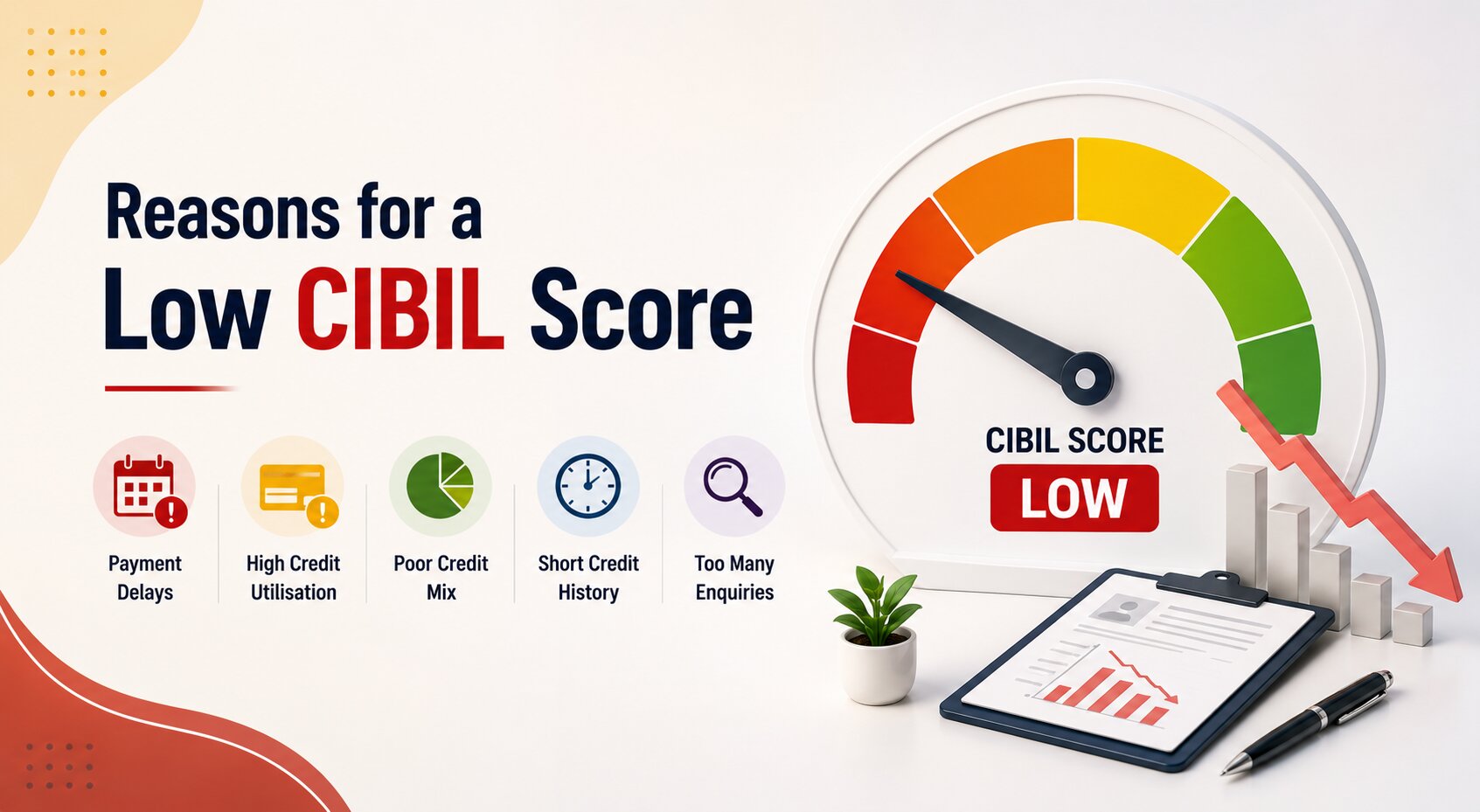
The numeric score range is 300 to 900 points. A low CIBIL score is relative, and banks have their own sourcing benchmarks. A CIBIL score of 750 points is required to be granted credit, and a score below 650 points is considered low. If you have a low CIBIL score, you may face the following issues:
- Difficulty is securing a Personal Loan.
- Secure loans are granted at a higher interest rate.
- Lower limits assigned to credit cards.
The CIBIL score is generated based on an individual’s credit transactions. A score is allotted based on the following Credit behaviour patterns:
The percentages allotted by CIBIL
| Credit Usage and history |
35% |
| Existing Credit Utilisation |
30% |
| Credit Mix |
15% |
| Credit vintage |
20% |
Key Reasons for a low CIBIL score
Keeping a tab on your CIBIL score is necessary. You can check your CIBIL score online from www.CIBIL.com, from your Bank account or through a payment App. If the decline in your CIBIL score has come as a surprise, you need to check the reasons for the low score. The major reasons for a Low CIBIL score can be classified as follows:
Credit usage and credit history
The credit history accounts for 35% of the CIBIL score: previous credit usage and repayment records are a mark of your credit management and will significantly affect your CIBIL score. Timely repayment of credit will add to your credit score. The following lapses can be the reason for a low CIBIL score:
- Delayed payment of EMI: The instalment for your loan repayment is deducted from your bank account on the scheduled date. If there are insufficient funds in the account, the transaction will be returned unpaid and recorded as a bounce in your CIBIL history. A history of delayed loan repayments will downgrade your CIBIL score.
- Non-payment of Credit card bills : A credit-free period of 40 to 50 days for credit card usage is allotted by most Banks. A payment statement is generated for the amount due by the due date. Non-payment of the bill or of the minimum amount of 5% is reported to CIBIL, and the delay is further recorded in buckets of 30, 60 or 90 days.
- Pending Accounts. The repayment of loans must be completed and confirmed with a no- dues certificate from the Bank. All pending accounts will incur interest, remain on the CIBIL history, and prevent the CIBIL score from increasing. If not paid, it will be marked as delinquent over time.
- Settlement of pending dues : Customers unable to make timely repayment of dues may opt for a settlement. A settlement involves payment of overdue amounts without interest. The Bank treats it as a compromise rather than a payment in full. A settled account is viewed unfavourably and is a major reason for a low CIBIL score. A settlement is not a good option, as the account will be classified as being in default.
Existing Credit Utilisation
Past discrepancies can be overlooked if the customer is diligently repaying current credit dues. CIBIL allocates 30% of the score to an individual’s current credit utilisation. The customer’s current credit usage reflects their current financial stability. Take note of the following, which can be reasons for a low credit score.
- EMI returns or bounces: A return of a loan instalment or a bounced cheque for a credit card payment will hit your CIBIL score and be recorded in your CIBIL history. Prompt repayment is essential, though you may not be issued further credit for the next three months.
- Excess utilisation of Credit: A balanced usage of credit, up to 60% of monthly income, is an ideal ratio. Excess credit appended suddenly from multiple lenders and Application loans indicate that the customer’s liabilities are stretching his income. The repayments can become unaffordable, increasing the risk of delays. The CIBIL will also reflect that the customer is “Overleveraged”.
- Maximised Credit Cards Usage: Credit cards are handy payment options with a credit-free period of 30 to 40 days; payments for spending must be made on the due date, failing which a high interest rate of 36% to 40% is charged. Overuse of credit cards and failure to clear bills promptly signal financial stress and lead to a decline in the CIBIL score.
A mix of Credit Usage
Customers using a mix of secured and unsecured credit are likely to have a stable CIBIL score; using only mortgages, auto loans, or credit cards will not give the CIBIL score the required boost. 20% of your CIBIL score is allotted to the credit mix.
- Unsecured Credit: An unsecured credit card or a personal loan is provided free of collateral. Responsible usage gives the lender confidence and helps build a credit score quickly.
- Secured credit: Repaying a mortgage is a long-term responsibility for a customer. Home loans with a tenure of 20 years or more allow CIBIL to assign scores based on the vintage of credit usage and timely repayment.
Insufficient Credit history
The CIBIL score is based on a customer’s credit behaviour over time. It takes 6 months to 1 year for CIBIL to generate a reasonable score. 20% of the score is allocated to building a credit history through regular credit use and timely repayments.
Too many CIBIL Enquiries
Each time you apply for credit, the lender will send an inquiry to CIBIL to review your CIBIL score and history; each inquiry will lower your CIBIL score by 10 points. For example, if you apply to 3 lenders simultaneously for a personal loan, your CIBIL score is hit by 30 points. More than 3 to 4 inquiries in the past 3 months can lead to the rejection of a credit card or personal loan request.
Errors in the CIBIL report
Regular credit usage and timely EMI payments, and still facing a personal loan rejection? You need to check your CIBIL history for errors; the error could be due to a wrong report sent by a lender or a clerical error by CIBIL. Retrieve your CIBIL report to check for wrong entries that could be the cause of a Low CIBIL score. Take steps to rectify your CIBIL score.
Reasons for Credit Delays and Defaults that impact a CIBIL Score
Delays and defaults in repaying credit taken are due to the simple shortage of funds or for other reasons, notable are the following;
- Change of the ECS mandate bank account: If your salary account changes, the Bank should be informed in advance, and a request for a change of the ECS mandate should be made. If the Bank is not notified in time and there are insufficient funds, the EMI will return unpaid and will reflect in your credit history as a bounce.
- Loss of Employment: If you are unemployed, without a regular salary, it is advisable to arrange funds from other sources and maintain a sufficient balance in your account to clear the EMI . If you have outstanding credit card debt, pay the minimum balance by the due date to avoid default.
- Delay in salary credited: The EMI will be credited to the salary account on the due date. If the employer does not credit your salary on the assigned date, the EMI will be marked as unpaid. It is advisable to keep one month’s instalment as an advance, in case the salary credit is delayed.
- Unable to manage finances properly: If the expenses have increased due to unplanned expenditures, and you have made extensive usage of your credit card, individuals who are unable to manage their finances in such situations are liable for default.
What steps can you take to improve your CIBIL score?
- Reset of your Credit records: You cannot change your past credit history as recorded by CIBIL , but you can always work at making a fresh start.
- Try to clear the previous debt: If your financial situation improves, it is the best solution to repay the amount due and clear your debts. Repaying the outstanding amount, including interest, will close the account and improve your CIBIL score.
- Restart your history with commodities: Start rebuilding your score by purchasing commodities with your Credit or Debit card , convert the spend into EMI , and make sure you repay the instalments on time.
- Apply for a secured credit: a Gold Loan or a Loan Against Property , which requires a lower CIBIL score due to the security provided, can help you get the finance you need and improve your CIBIL score.
- Look for a successful relationship: A lender with whom you have a salary account, with a good average bank balance. Your CIBIL score may be overlooked as you have maintained a good repayment record with the lender.
Conclusion: Your CIBIL score calculations are not rocket science, but a follow-up and a consolidated report of your credit usage. A clear understanding of the CIBIL score ratings, as given above, will help you to avoid a Low CIBIL Score.


 May 19, 2026