 91-9711165183


Yes, you can get a personal loan for freelancers in India even without a salary slip. Lenders assess repayment ability through bank statements, ITRs or GST returns, and your credit score. Most NBFCs and digital lenders approve freelancers with a CIBIL score around 650 to 700 and steady monthly credits, with rates starting from about 10% to 11.99% per annum (subject to eligibility, as of July 2026).
Freelancing pays well in India, but it does not fit neatly into the salary-slip box that banks were built around. If you write code, design brands, shoot weddings, edit video, or consult across three clients at once, your income is real, just irregular. That mismatch is exactly why a personal loan for freelancers needs a different playbook. This page sheds light on who qualifies, what documents work when you do not have a fixed salary, the interest rates lenders are quoting right now, and the practical steps that get a freelance application approved rather than rejected.
The freelance base is not small, either. According to NITI Aayog’s report on India’s gig and platform economy, the country had around 77 lakh gig workers in 2020-21, projected to reach 2.35 crore by 2029-30 (NITI Aayog, 2022). Lenders have noticed, and several have built products around variable-income borrowers.
A salaried applicant hands over three pay slips and a Form 16, and the lender knows almost exactly what lands in the account every month. A freelancer cannot do that. Income arrives in lumps, a big invoice one month, a dry spell the next, so lenders read your profile through a wider lens:
None of this makes you ineligible. It just means the evidence you present matters more than it would for a salaried colleague.
Eligibility for a personal loan for freelancers is built around income stability rather than an employment letter. The exact bar varies by lender, but the common requirements look like this:
| Criteria | Typical requirement (indicative) |
|---|---|
| Age | 21 to 60 years at maturity (some NBFCs start at 18) |
| Citizenship | Indian resident |
| Minimum monthly income | ₹15,000 to ₹25,000, averaged over 6 to 12 months |
| Credit score (CIBIL) | 650+ for NBFCs; 700 to 750+ for better bank rates |
| Work vintage | 1 to 2 years of freelance track record preferred |
| Banking | Consistent inflows into a bank account, healthy average balance |
Indicative ranges compiled from lender product pages, as of July 2026.
A quick reality check on the numbers above: DMI Finance, one of the NBFCs that lends to freelancers, lists a minimum income of ₹25,000 per month, an age band of 23 to 52, and a credit score of 700 or more on its freelancer product page (DMI Finance, as of July 2026). Stashfin sets its bar lower, at a fair credit score of 650 or above and a minimum monthly income around ₹20,000 (Stashfin, as of July 2026). The takeaway: bars differ, so a rejection from one lender does not mean you are out of options.
If you want to gauge where you stand before applying, use our [personal loan eligibility guide](https://www.yourloanadvisors.com/personal-loan-eligibility/) to sanity-check your profile first.
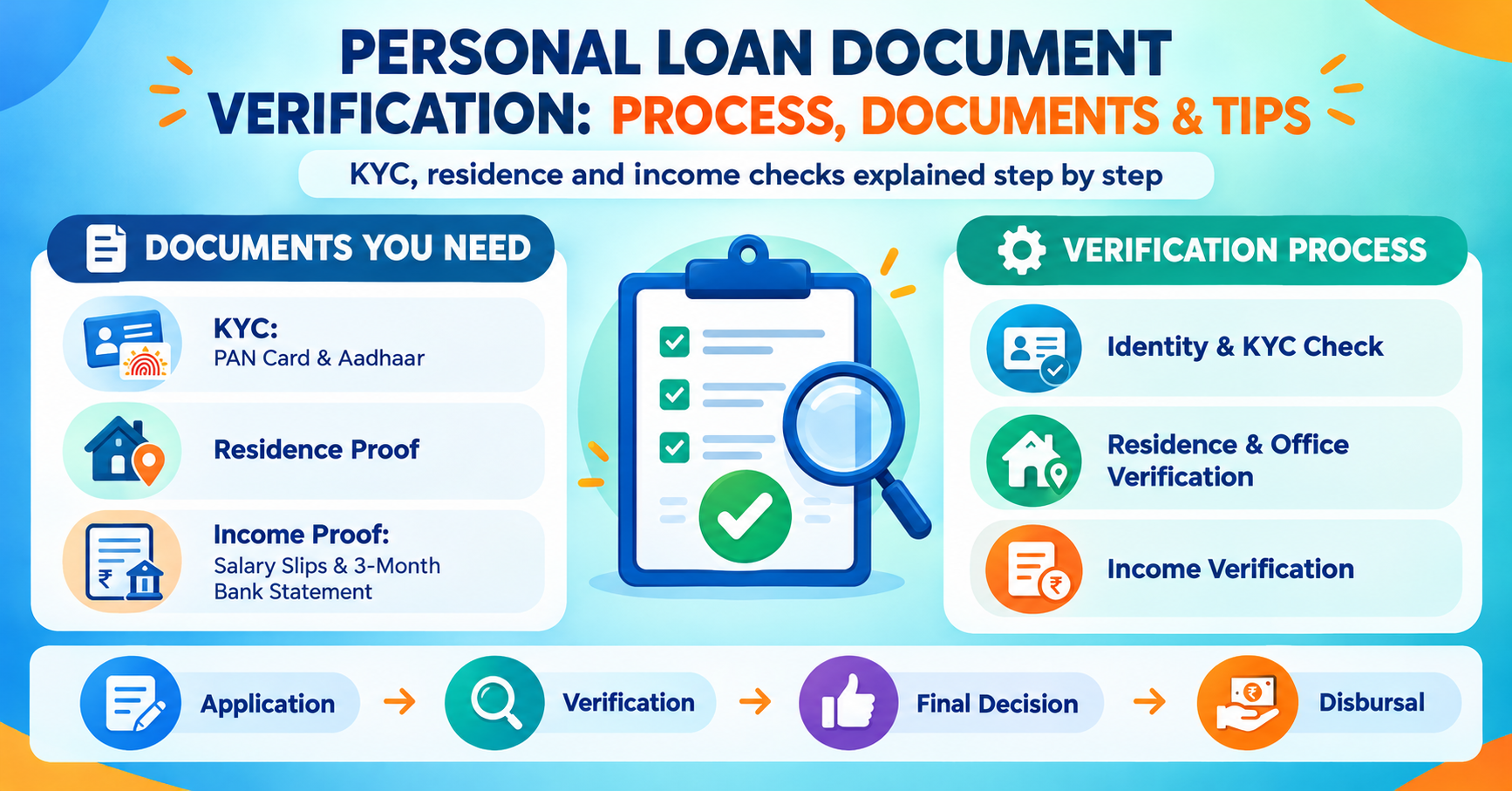
For a freelancer, documentation is the whole ball game. Here is what most lenders ask for:
Identity and address (KYC):
Income proof, the part that matters most:
Not every freelancer has clean ITRs, and lenders know it. That is why bank statements and GST filings have become acceptable stand-ins, especially with NBFCs and digital lenders.
This is the single biggest question freelancers ask, and most competitor pages skate over it. So here is the honest version.
Traditional banks usually insist on 2 to 3 years of ITRs. If you do not have them, banks are a hard route. NBFCs and fintech lenders are far more flexible and will often approve on the strength of alternatives:
A stronger credit score does a lot of heavy lifting here. If you cannot show ITRs, a CIBIL score above 700, a co-applicant with steady income, or a slightly smaller loan amount can all tilt an approval your way. The tradeoff for skipping ITRs is usually a higher rate and a lower sanctioned limit, which is a fair deal if the alternative is no loan at all. A personal loan for self-employed follows the same logic if you run a registered practice.
Rates for freelancers sit at the higher end of a lender’s published band, because published starting rates (the eye-catching 9.99% onwards) are typically reserved for salaried borrowers with strong scores and existing relationships. As a self-employed freelancer, budget for a rate above the advertised floor.
Here is where major lenders stand, with figures taken from their own rate cards and product pages:
| Lender | Indicative rate (p.a.) | Loan amount | Notes |
|---|---|---|---|
| HDFC Bank | 9.99% to 24% | ₹50,000 to ₹40 lakh | Processing fee up to ₹6,500 + GST; tenure 12 to 60 months (HDFC, Jul 2026) |
| ICICI Bank | 9.99% to 16.5% | As per profile | Rate varies by profile and bank relationship (ICICI, Jul 2026); amount |
| Bajaj Finserv | 10% to 30% | Up to ₹55 lakh | Tenure 12 to 108 months; NBFC (Bajaj, Jul 2026) |
| Stashfin | 11.99% onwards | Up to ₹5 lakh | 0% for first 30 days; platform fee 2% to 3.5%; nil foreclosure (Stashfin, Jul 2026) |
| DMI Finance | Rate on application | ₹50,000 to ₹5 lakh | Digital; disbursal 24 to 72 hours (DMI, Jul 2026) |
Rates and charges as of July 2026 and subject to change. Bank starting rates generally apply to salaried, high-score profiles; freelancers should expect the higher end of each band. Verify current figures on each lender’s official page before applying.
Our review found the honest spread for a freelancer with a fair-to-good score usually falls somewhere between 11% and 24% per annum, depending on documentation strength and loan size. The 0% interest-free window some fintechs advertise applies only to very short repayment periods (Stashfin’s is up to 30 days), so read that fine print rather than treating it as a headline rate.
Behind the scenes, a lender is trying to answer one question: can this person comfortably repay the EMI every month? For freelancers, they get there through a few checks:
Knowing this, you can see why cleaning up your bank statements for six months before applying is not just folklore, it is exactly what the underwriter is reading.
Numbers make this concrete. Say you borrow ₹5,00,000 over 3 years (36 months) at 14% per annum on a reducing-balance basis. The EMI works out to roughly ₹17,100 per month, and total interest over the loan is about ₹1,15,000. Push the tenure to 5 years and the EMI drops to around ₹11,600, but total interest climbs to roughly ₹1,98,000.
EMI figures are illustrative, calculated on a standard reducing-balance basis; your actual EMI depends on the sanctioned rate and tenure. Use an [EMI calculator](https://www.yourloanadvisors.com/personal-loan-emi-calculator/) to model your own numbers.
The lesson for irregular income: a longer tenure lowers the monthly pressure during dry spells, but you pay materially more interest overall. Many freelancers split the difference, taking a comfortable tenure and then part-prepaying after a strong month, which is why nil or low foreclosure charges are worth prioritising.
Meera, a 29-year-old freelance UX designer in Pune, works with three retainer clients and bills roughly ₹90,000 in a good month and ₹40,000 in a slow one. She wanted ₹4,00,000 to upgrade her workstation and consolidate a credit card balance.
She had no salary slip and only one year of ITRs. Here is what worked:
1. She led with 12 months of bank statements showing steady retainer credits, which averaged to about ₹62,000 a month.
2. She added her two retainer contracts to prove the income was recurring, not one-off.
3. She cleared a small card balance first, nudging her CIBIL score from 690 to 728 and freeing up her FOIR.
4. She applied for ₹4 lakh, not ₹8 lakh, keeping the EMI well within 40% of her average income.
5. Disbursal followed KYC and verification, with funds credited within a few working days.
The persona is illustrative, but the sequence is exactly how a strong freelance application is built.
The interest rate is only part of the cost. Before you sign, check:
Under RBI rules, lenders must give you a Key Facts Statement (KFS) that lays out the all-in cost, including the Annual Percentage Rate, before you accept a retail loan (RBI Key Facts Statement guidelines, April 2024). Read it. It is the single clearest document for comparing two offers honestly.
Freelance income does not fit a template, and matching it to the right lender is where most applications go wrong. At yourloanadvisors.com, our advisors work with variable-income borrowers to line up the documentation, flag the lenders most likely to say yes to a freelance profile, and help you avoid the scattergun applications that hurt your credit score. Rather than a generic form, you get guidance tailored to how freelancers actually earn.
Talk to an advisor at yourloanadvisors.com to check which freelancer-friendly loan options fit your profile and apply with us.
Yes. While traditional banks usually require 2 to 3 years of ITRs, many NBFCs and digital lenders approve freelancers on the strength of 6 to 12 months of bank statements, GST returns, and a fair credit score, subject to eligibility.
There is no single best; the right personal loan for freelancers depends on your credit score, income proof, and how much you need. NBFCs and fintechs tend to be more flexible on documentation, while banks offer lower rates to strong, well-documented profiles.
Many lenders look for a minimum monthly income of ₹15,000 to ₹25,000, averaged over several months (indicative, as of July 2026). The exact bar varies by lender.
A CIBIL score of 650 or above opens the door with most NBFCs; 700 to 750+ helps you access better rates and higher amounts.
Typically a multiple of average monthly income, subject to FOIR and repayment capacity. Amounts commonly range from ₹50,000 up to a few lakh for unsecured freelancer loans, and higher for very strong profiles.
Most are unsecured, meaning no collateral is required. Approval rests on income proof and credit history instead.
Digital lenders can approve in minutes and disburse within a few hours to a few working days once documents and verification are complete. Timelines vary by lender and are not guaranteed.
Often yes. Some lenders charge nil foreclosure fees while others levy a percentage, so confirm the prepayment terms before signing, especially useful for lumpy freelance income.
Not on its own. Lenders average your income over several months. Consistent credits and a healthy balance matter more than a perfectly flat month-to-month figure.
Interest rates, fees, and eligibility criteria mentioned here are indicative, sourced from lender pages as of July 2026, and are subject to change. This article is information, not financial advice. Confirm all current terms directly with the lender or with our experts before applying.