 91-9711165183


A personal loan for chartered accountants is a collateral-free loan priced against your practice income and ICAI credentials rather than a monthly salary slip. Indicative rates start from around 9.99% per annum (as of July 2026), with amounts up to Rs 1 crore, subject to eligibility, credit score and lender policy.
Chartered accountants sit on the trusted side of India’s financial system, yet many find that the standard personal loan form was built for a salaried borrower, not for a professional whose income arrives in retainers, audit-season spikes and quarterly filings. The good news: most banks and NBFCs now run dedicated CA loan or professional loan programmes that read your ITRs and practice profile instead of asking for a Form 16 you do not have.
India has more than 4 lakh ICAI members, of whom over 1.5 lakh hold a Certificate of Practice (as of the 2025 ICAI membership data), and lenders compete hard for this low-default segment. That competition is your leverage. This page breaks down how a personal loan for chartered accountants is priced, who qualifies, which documents replace the salary slip, and how to read the fine print before you sign.
How Personal Loans Help Chartered Accountants [Credit Solutions]
A CA’s cash flow is lumpy by design. Fees cluster around statutory deadlines, clients delay payments, and the practice itself needs periodic investment. A personal loan smooths that gap without diluting equity or pledging assets. Common reasons CAs borrow:
Since a personal loan is unsecured, you are not risking your home or portfolio. The trade-off is that pricing leans heavily on your credit score and documented income, which is where a CA’s clean records usually help.
Two loans with the same headline rate can cost very differently once you read past the banner. Before you compare a personal loan for chartered accountants across lenders, line up these features.
This single distinction changes your real cost more than a half-percent difference in the quoted rate.
| Rate type | How it works | What CAs should watch |
|---|---|---|
| Reducing balance | Interest charged only on the outstanding principal, which falls with each EMI | The rate most lenders quote; compare like-for-like |
| Flat rate | Interest charged on the full original principal for the whole tenure | A ‘low’ flat rate is usually costlier than it looks; convert to reducing |
Always ask for the effective annual rate on a reducing-balance basis, plus the annualised percentage rate (APR) that folds in the processing fee. A flat rate that sounds cheaper often works out to a higher APR.
Several lenders waive the standard income-proof stack for ICAI members and accept the Certificate of Practice plus ITRs as the core evidence. If a lender still insists on salary-style proofs from a practising CA, that is a sign their programme was not really built for professionals.
A few NBFCs offer flexi or line-of-credit structures where you draw as needed and pay interest only on the utilised amount, which suits a practice with uneven cash flow. Top-up eligibility on an existing clean loan can also be cheaper and faster than a fresh application. Weigh these against the extra fees they sometimes carry.
The table below compares indicative CA and professional loan offers from major banks and NBFCs. Figures are indicative as of July 2026 and are drawn from each lender’s official product pages. Please note that every rate is subject to your eligibility, credit profile and the lender’s policy at the time of application.
A quick distinction: Poonawalla Fincorp and IDFC FIRST Bank run dedicated CA or professional loan programmes, whereas HDFC Bank, Axis Bank and ICICI Bank are general personal loans that a CA applies for as a self-employed professional.
| Lender | Indicative rate (p.a.) | Loan amount (up to) | Tenure | Notes / fees |
|---|---|---|---|---|
| Poonawalla Fincorp | From 9.99%* | Rs 50 lakh | Flexible | Bounce charge Rs 500; no-hidden-charge positioning |
| IDFC FIRST Bank | From ~11% | Rs 1 crore | 12 to 84 months | Collateral-free; instant offers up to Rs 30 lakh |
| HDFC Bank | From 9.99%* | Rs 50 lakh | 12 to 60 months | Personal loan; self-employed rate typically higher |
| Axis Bank | From 9.99%* | Rs 40 lakh | 12 to 84 months | Personal loan; profile-based, up to ~22% p.a. |
| ICICI Bank | From 9.99%* | Rs 50 lakh | 12 to 72 months | Personal loan; best rate for salary-account holders |
Sources: Poonawalla Fincorp, IDFC FIRST Bank, HDFC Bank, Axis Bank, ICICI Bank. HDFC, Axis and ICICI figures are general personal-loan starting rates from each bank’s official rate page; the rate offered to a self-employed CA is typically higher and subject to eligibility (as of July 2026).
Our reading: Poonawalla’s sub-10% starting rate and IDFC FIRST’s Rs 1 crore ceiling look the most aggressive on paper, but a starting rate is a best-case number reserved for high-score, high-income applicants. The big private banks, HDFC, Axis and ICICI, all advertise personal loans from 9.99%, yet a practising CA is usually offered a profile-based rate above that floor. Compare the rate you are actually quoted, not the banner.
Eligibility rules vary by lender, but the underwriting logic is consistent: prove stable, documented professional income and a clean repayment history. Typical criteria across major lenders (as of July 2026):
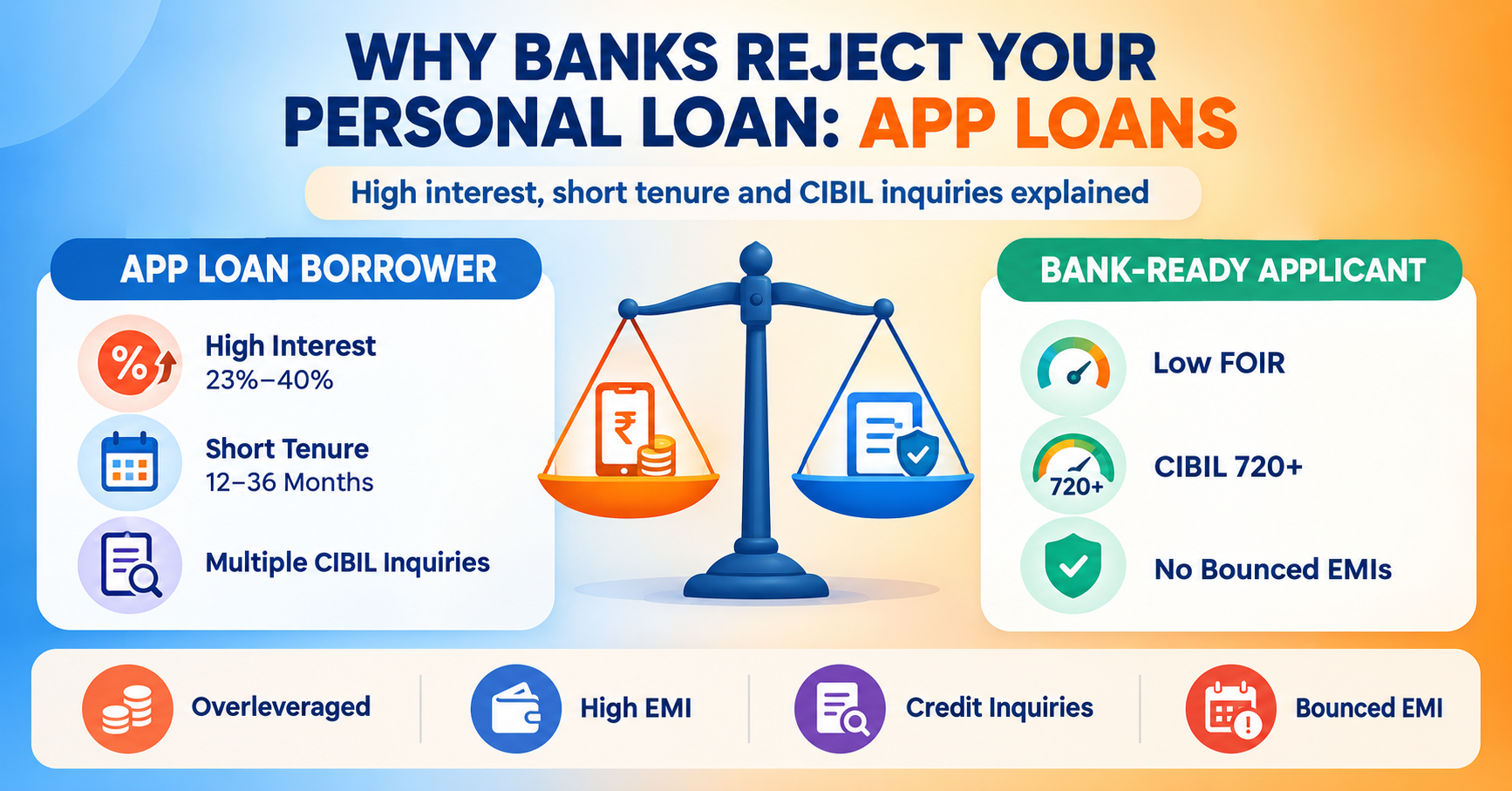
Lenders publish their exact cut-offs on their product pages, and the underwriting also weighs your existing obligations (your FOIR, or fixed-obligation-to-income ratio). You can sanity-check your own score for free through CIBIL before you apply.
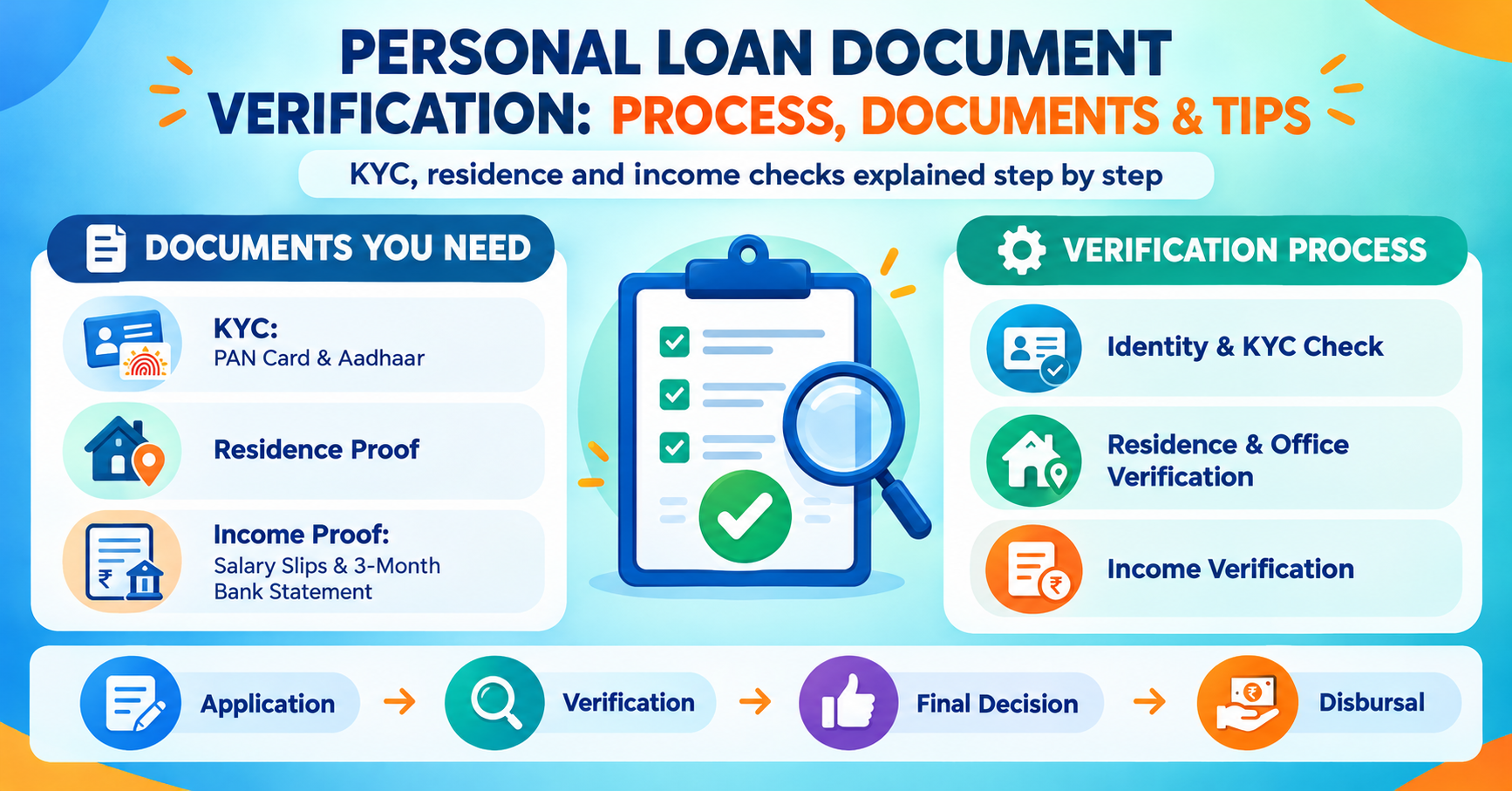
Keeping this set ready before you apply shortens approval time and reduces back-and-forth queries.
A practising CA can often complete the file faster than a typical self-employed applicant precisely because these records are already maintained to professional standards.
This is where a professional’s file differs most from a salaried borrower’s, and where applications either sail through or stall.
The underlying rule is simple: lenders lend against income they can see and verify in your ITRs and bank statements, not against income you describe. Route practice receipts through your bank and your file will speak for itself.
Your EMI is a function of three inputs: the loan amount (principal), the interest rate, and the tenure. On a reducing-balance loan, the standard EMI formula is EMI = P x r x (1+r)^n / ((1+r)^n – 1), where P is the principal, r is the monthly interest rate, and n is the number of months.
A worked example, indicative only: a Rs 15 lakh loan at 12% per annum over 5 years (60 months) works out to an EMI of roughly Rs 33,367, with total interest of about Rs 5.02 lakh over the tenure. Stretch the same loan to 7 years and the EMI falls but the total interest rises. A shorter tenure costs more each month and less overall.
Keep your total EMIs, across all loans, within about 40% to 50% of your net monthly income. Because a CA’s income is seasonal, budget against a conservative average month, not your best audit-season month. If a lender is willing to approve an EMI that only your peak months can service, that is a risk you carry, not the lender.
Run your own numbers before you commit using an EMI tool such as our [personal loan EMI calculator](https://www.yourloanadvisors.com/personal-loan-emi-calculator/), and compare the total interest outgo across tenures, not just the monthly figure.
There is no single best lender for every CA. The right fit depends on your loan size, how fast you need funds, and whether your income file is clean and salaried-like or seasonal and practice-based.
Shortlist on total cost (rate plus fees plus foreclosure terms), not on the headline rate alone. A slightly higher rate with zero foreclosure charges can beat a lower rate that locks you in.
1. File and keep clean ITRs. Two to three years of consistently filed returns are the single strongest signal a CA can offer. Do not under-report income in the years before you plan to borrow.
2. Route receipts through your bank. Visible, regular credits that match your billing turn a seasonal income into a bankable one.
3. Protect your credit score. Pay every EMI and credit-card due on time, keep card utilisation low, and avoid a flurry of loan applications, since each hard inquiry dents your score.
4. Apply to fewer lenders, deliberately. Multiple simultaneous applications read as credit-hungry behaviour. Compare first, then apply to one or two well-matched lenders.
5. Add a co-applicant if your file is thin. A spouse or family member with a stable income and good score can lift both your eligible amount and your rate.
6. Borrow within your repayment capacity. Asking for an EMI your average month can service, not just your peak month, both improves approval odds and protects you later.
Meera Nair, 34, is a practising chartered accountant in Kochi with a six-year-old solo practice. Audit season has just ended, and she wants Rs 12 lakh to lease a larger office and hire two articled assistants before the next filing cycle.
Meera’s file worked because her income was documented and visible, not because her practice was large. That is the pattern lenders reward. (Illustrative example; individual outcomes, timelines and rates vary by lender and profile.)
At yourloanadvisors.com, we work with chartered accountants who are tired of being underwritten like salaried employees. We understand professional income: retainers, seasonal receipts and ITR-led files. Rather than pushing a single product, we help you understand where your profile fits, what documentation strengthens your case, and how to compare offers on total cost instead of the banner rate.
Our editorial reviews are built on lender product pages and primary sources, not guesswork, so you walk into an application knowing what to expect.
Ready to see where you stand? Check your eligibility with our advisors and get a clear, no-pressure read on your options.
It is a collateral-free loan offered to CAs, priced on your professional income, ITRs and ICAI credentials rather than a salary slip. Many lenders brand it as a CA loan or professional loan and ease the documentation for members in practice.
Indicative starting rates run from about 9.99% per annum upward (as of July 2026), depending on your credit score, income, loan amount and lender. The rate you are actually offered can be higher than the advertised starting rate.
Depending on the lender and your income, amounts range from around Rs 5 lakh up to Rs 1 crore for large professional or practice-expansion loans, subject to eligibility.
No. These are unsecured loans, so you do not pledge property or investments. Pricing therefore depends more heavily on your credit score and documented income.
Typically PAN, Aadhaar, ICAI membership certificate and Certificate of Practice, two to three years of ITRs, practice financials, and 6 to 12 months of bank statements. Retainer letters can strengthen a seasonal income file.
Yes. A salaried CA is usually assessed like other salaried professionals, using salary slips and Form 16, while a practising CA is assessed on ITRs and practice income. Those with both income streams can disclose both.
A score below 700 narrows your options and raises your rate, but does not automatically disqualify you. Some NBFCs consider 650 and above. Improving your score before applying usually pays for itself at a lower rate.
Often, yes. Because CAs are a low-default segment, dedicated CA loan programmes can price below a standard personal loan, though your individual rate still depends on your profile.
Usually yes, subject to the lender’s foreclosure terms and any charges. If you expect to prepay after a strong year, prioritise lenders with low or nil foreclosure charges when you compare.
This article is for information only and is not financial advice. Interest rates, fees, eligibility criteria and other terms are indicative, dated where stated, and subject to change at the lender’s discretion. Verify all figures and conditions directly with the lender or with our experts before acting. Loan approval and terms depend on individual eligibility and lender policy; no approval, rate or disbursal timeline is guaranteed.